2026 Accumulated Cyclone Energy [ACE]
| Basin | Current YTD | Normal YTD | % of Normal YTD | Yearly Climo* | 2025** |
|---|---|---|---|---|---|
| Northern Hemisphere | 75.3675 | 64 | 117% | 575 | 461 |
| Western N Pacific | 71.28 | 42 | 169% | 298 | 188 |
| Eastern + Cent N Pac | 3.6825 | 13 | 28% | 132 | 118 |
| North Atlantic | 0.405 | 1 | 40% | 122 | 136 |
| North Indian | 0 | 7 | 0% | 23 | 9 |
| Southern Hemisphere | 214.203 | 209 | 102% | 205 | 256 |
| Global | 227.0425 | 236 | 96% | 780 | 736 |
*Yearly climatology from historical 1991-2020 Tropical cyclone best track datasets
**Preliminary values from real-time ATCF advisories and will become final when best-tracks are available from JTWC and NHC after post-season analysis
Small differences have been found in previous years between real-time and best-track ACE.
Southern Hemisphere Year-To-Date represents October 2025 - May 2026 activity
Please consider supporting this work by subscribing to Weather Trader Substack
Hurricanes and Climate Change
Around the globe, 80-100 tropical storms are observed every year unevenly distributed across the Indian, Pacific, and Atlantic oceans. About half go on to reach hurricane strength and a smaller percentage, about 1/4 become major hurricanes. The generic term tropical cyclone can be used to describe tropical storms, hurricanes and typhoons. While most tropical cyclones complete their lifecycle without impacting land, there are many each year that cause catastrophic damage and loss of life to coastal nations including the United States.While this statement focuses on the Atlantic Ocean basin, much of the information can be applied to the other ocean basins in a general sense. We present the most up-to-date information on how climate change is expected to impact hurricanes in the future. There are two complementary lines of evidence used to diagnose climate change effects upon hurricanes including (1) historical records of observed activity and (2) computer modeling. Many scientists have dedicated their careers to improve the understanding of hurricanes and published countless papers that help inform the scientific consensus: From the NOAA GFDL website (Link) : "In summary, it is premature to conclude with high confidence that increasing atmospheric greenhouse gas concentrations from human activities have had a detectable impact on Atlantic basin hurricane activity, although increasing greenhouse gases are strongly linked to global warming... Human activities may have already caused other changes in tropical cyclone activity that are not yet detectable due to the small magnitude of these changes compared to estimated natural variability, or due to observational limitations."
Regardless of the scientific ability to conclude confidently in every impact of climate change on hurricanes, they will continue to occur and devastate rapidly growing coastal regions. The only proven and practical way to prevent loss of life and property damage is to prepare ahead with improved building codes and maintain a high level of vigilance and resilience in the face of natural disasters. This includes more accurate intensity and track forecasting through advanced numerical weather prediction or weather models.
Note that lack of evidence does NOT mean absence of evidence. It means we currently have incomplete knowledge or inadequate methods and/or observations. We can still have medium to high confidence in an expected outcome based upon fundamental understanding of physics and fluids.
Peer-Reviewed Literature & Graphics
Recent historically low global tropical cyclone activity: Geophys. Res. Lett. (2011), Abstract:| Tropical cyclone accumulated cyclone energy (ACE) has exhibited strikingly large global interannual variability during the past 40-years. In the pentad since 2006, Northern Hemisphere and global tropical cyclone ACE has decreased dramatically to the lowest levels since the late 1970s. Additionally, the frequency of tropical cyclones has reached a historical low. Here evidence is presented demonstrating that considerable variability in tropical cyclone ACE is associated with the evolution of the character of observed large-scale climate mechanisms including the El Nino Southern Oscillation and Pacific Decadal Oscillation. In contrast to record quiet North Pacific tropical cyclone activity in 2010, the North Atlantic basin remained very active by contributing almost one-third of the overall calendar year global ACE. |
|---|
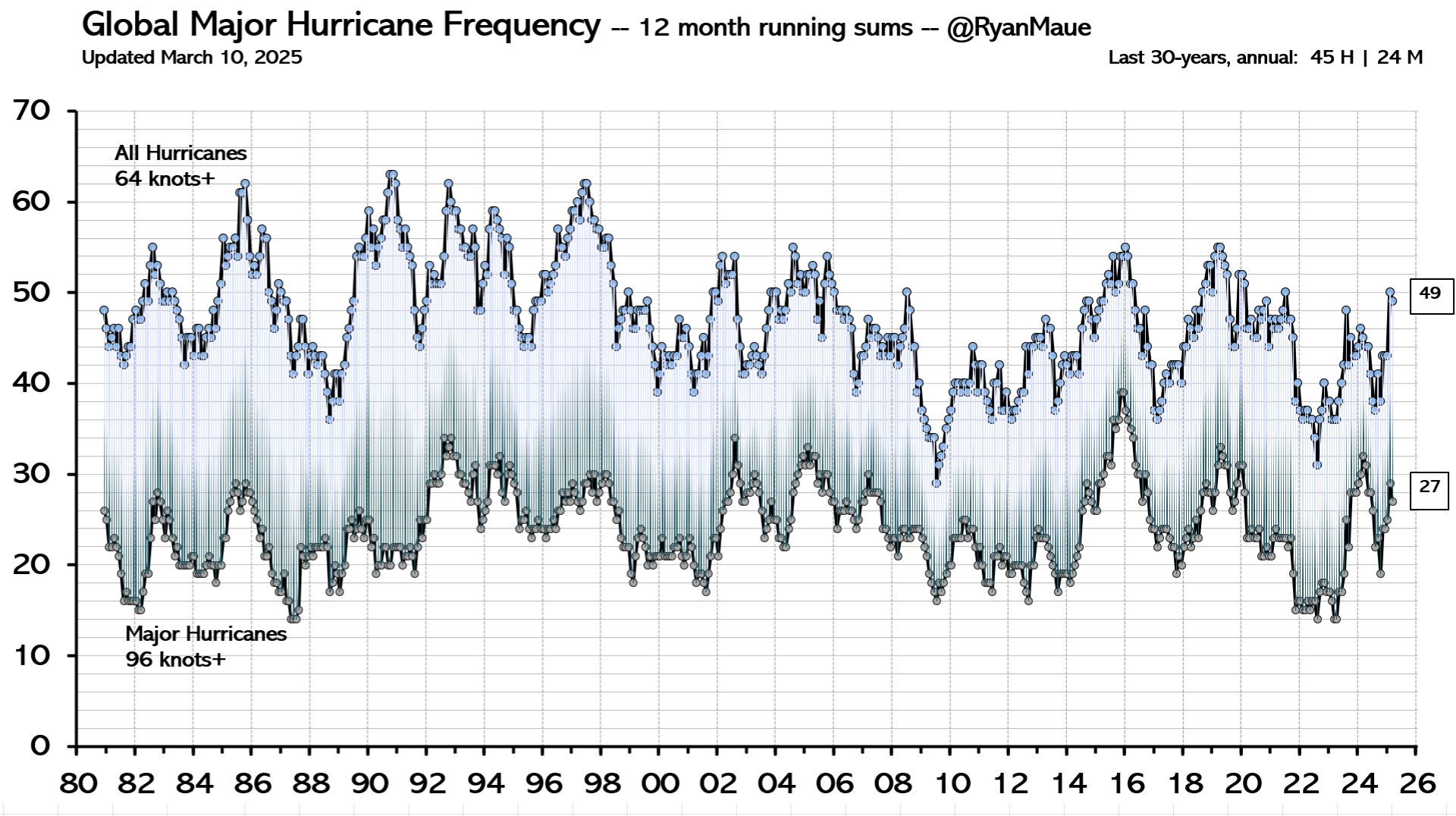
| Figure: Global Hurricane Frequency (all & major) -- 12-month running sums. The top time series is the number of global tropical cyclones that reached at least hurricane-force (maximum lifetime wind speed exceeds 64-knots). The bottom time series is the number of global tropical cyclones that reached major hurricane strength (96-knots+). Adapted from Maue (2011) GRL. |
|---|
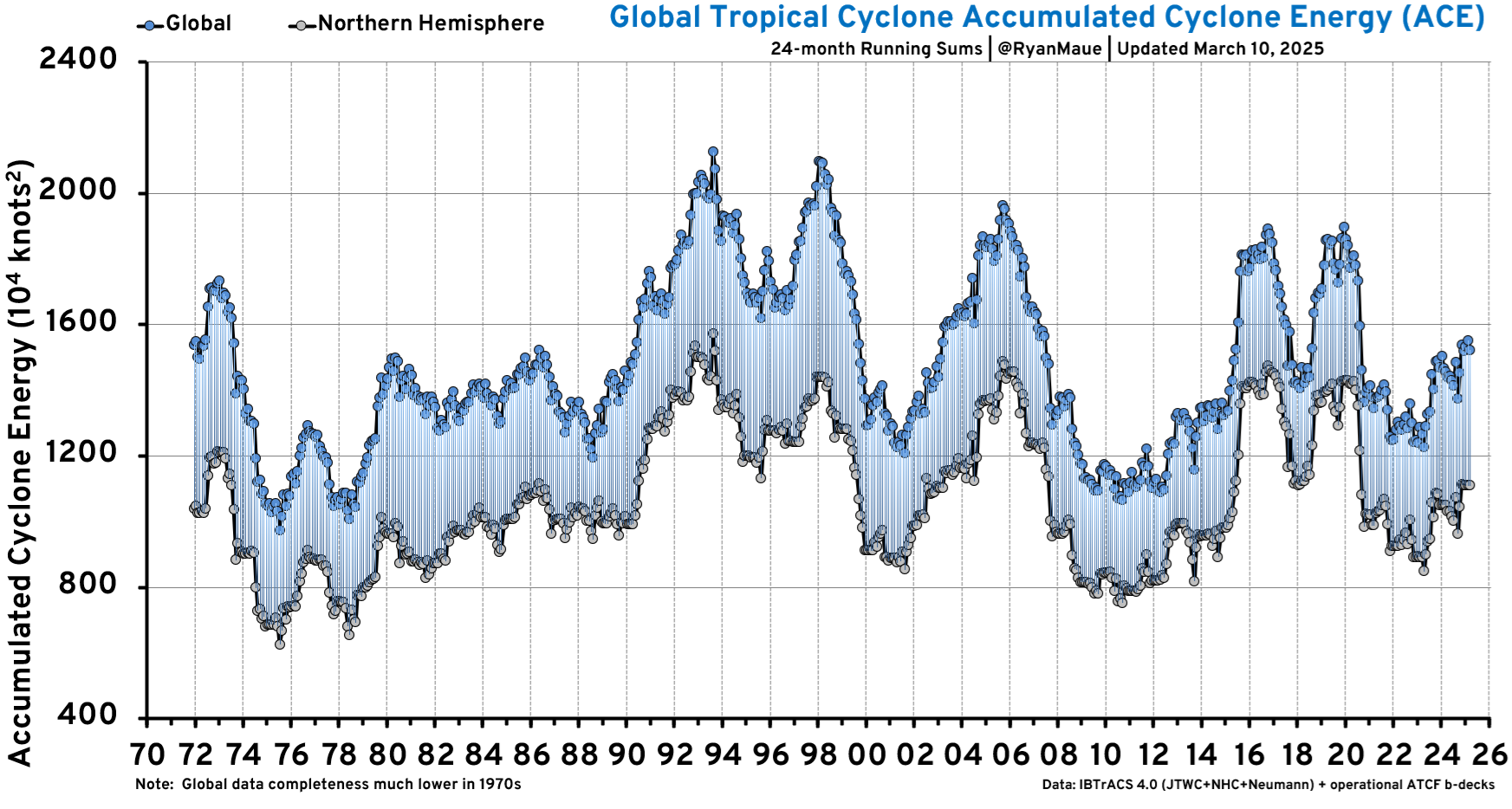
|
Figure:
Last 50-years+ of Global and Northern Hemisphere Accumulated Cyclone Energy: 24 month running sums. Note that the year indicated represents the value of ACE
through the previous 24-months for the Northern Hemisphere (bottom line/gray boxes) and the entire global (top line/blue boxes). The area in between represents the Southern Hemisphere total
ACE. |
|---|
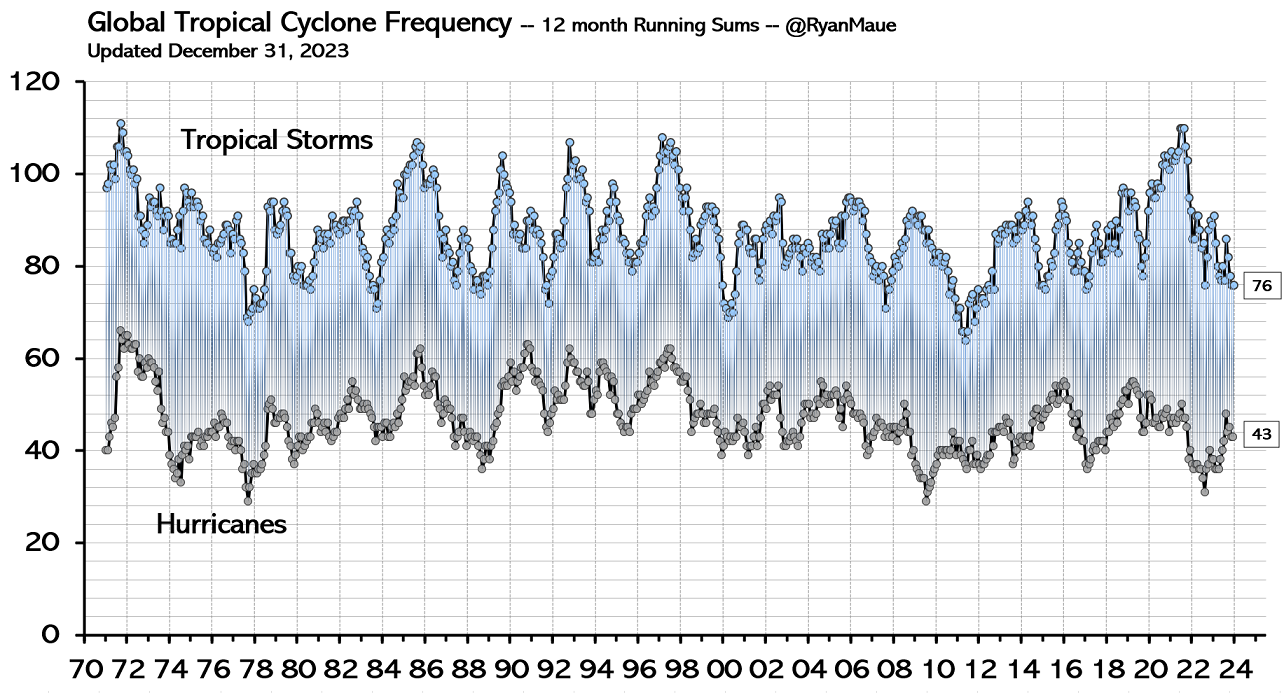
| Figure: Last 50-years+ of Global Tropical Storm and Hurricane frequency -- 12-month running sums. The top time series is the number of TCs that reach at least tropical storm strength (maximum lifetime wind speed exceeds 34-knots). The bottom time series is the number of hurricane strength (64-knots+) TCs. |
|---|
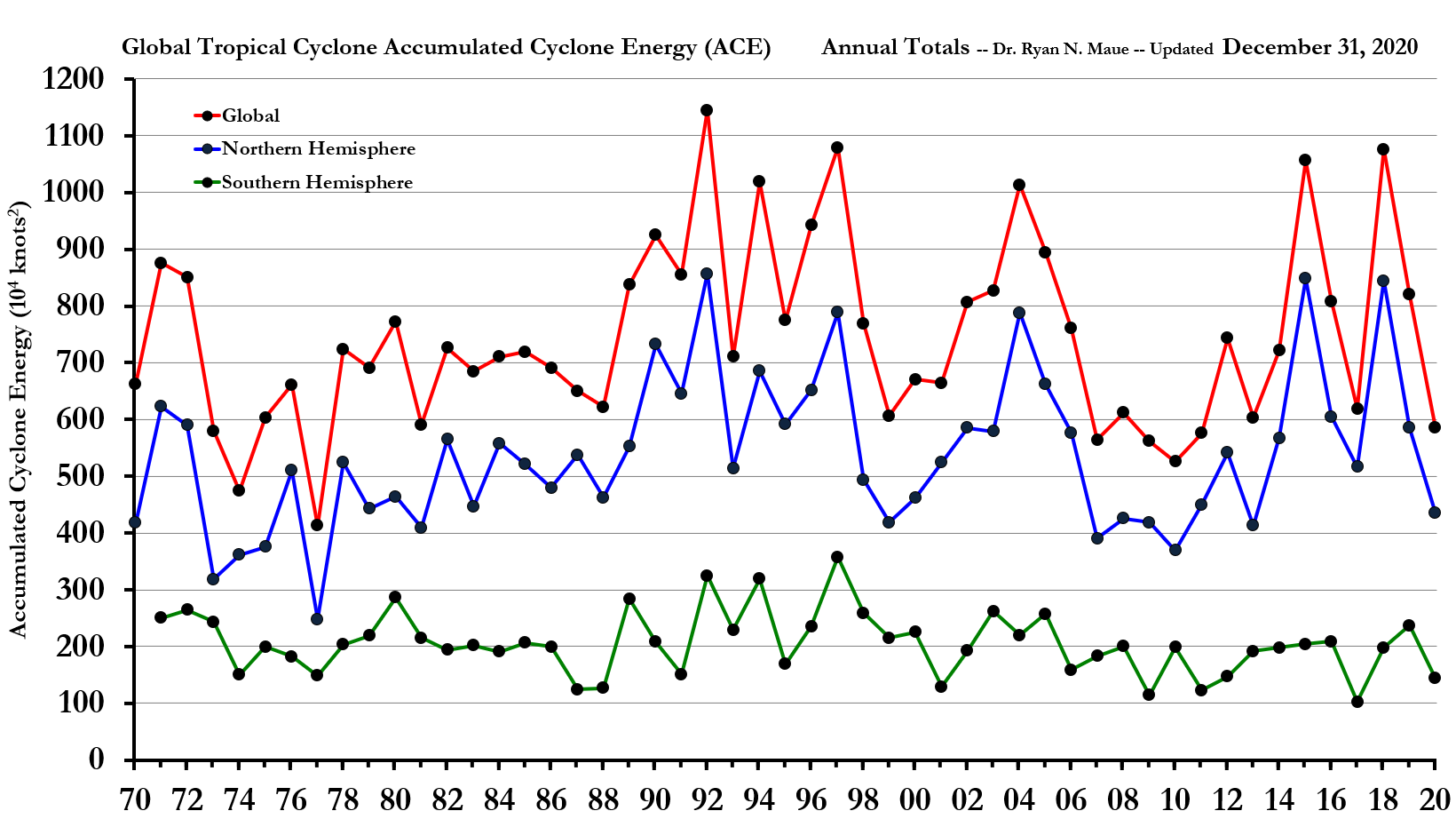
| Figure: Last 4-decades of Global Tropical Storm and Hurricane Accumulated Cyclone Energy -- Annual totals. The Southern Hemisphere tropical cyclone season occurs from July-June each calendar year. The graph is constructed such that SH annual value for July 2014 - July 2015 is positioned in 2015. |
|---|